Porphyrin Nanorings and Aromaticity
Spectroscopy and synthesis of large conjugated macrocycles and quantum rings.
Aromaticity is usually explained through a ring current. Place a molecule with a closed loop of electrons in a magnetic field, and if the loop satisfies Hückel’s rule, a circuit of 4n+2 pi electrons, the field induces a current that flows around the ring and generates its own opposing magnetic field inside the loop. A ring with 4n pi electrons instead is antiaromatic, and the induced current runs the other way. This is not a property you can read off any single atom in the ring. It only exists because the electrons are delocalized around the whole structure, which is what makes it worth measuring directly rather than inferring from bond lengths or reactivity.
Hückel’s rule was derived for small rings and reliably describes molecules with fewer than 22 pi electrons. Benzene, at 6 pi electrons, is the standard example. My DPhil work with Harry Anderson at Oxford, together with Michel Rickhaus and Martin Peeks, asked what happens to that rule at a completely different scale, in synthetic porphyrin nanorings large enough to see under a microscope rather than infer from a spectrum.
How Big Can a Ring Current Get
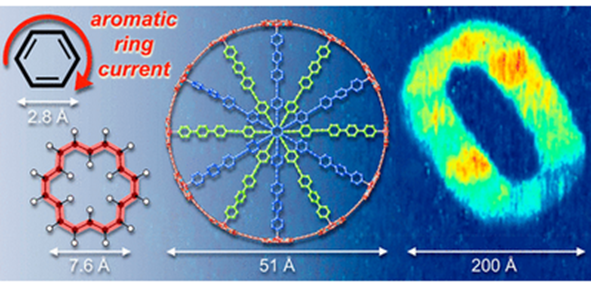
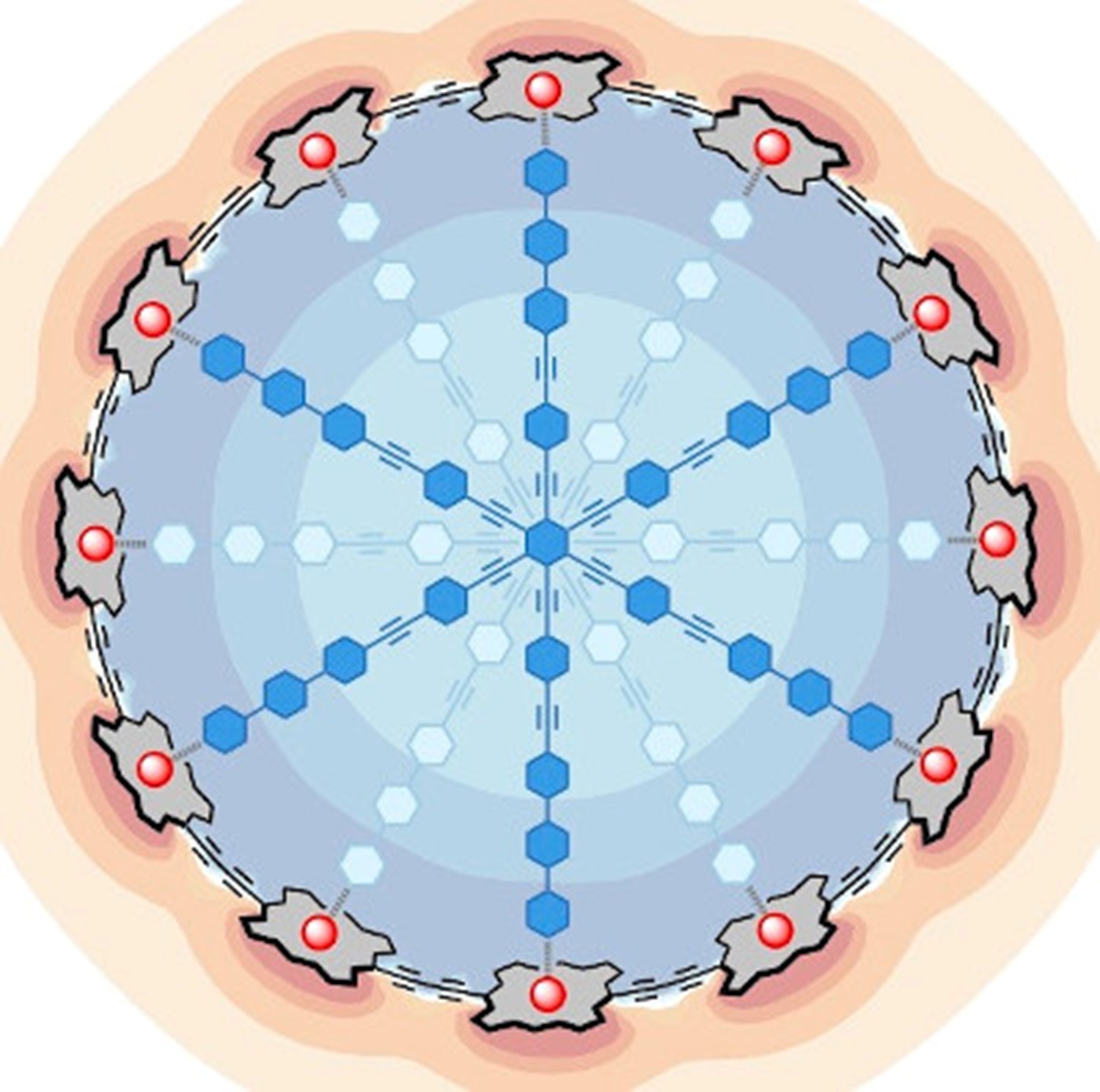
We built porphyrin nanorings with conjugated circuits of up to 162 pi electrons, roughly forty times the electron count Hückel’s rule was originally written for, and looked for a global ring current using nuclear magnetic resonance (Rickhaus et al., 2020). It was there. By changing the ring’s constitution, its oxidation state, and its conformation, we could turn the current on and off and switch its direction between aromatic and antiaromatic, and every time a current appeared, Hückel’s rule correctly predicted which way it would flow. That is not a small result to me. A rule written for six-electron rings was still getting the physics right on structures with a diameter of twenty nanometers.
Measuring the Energy, Not Just the Current
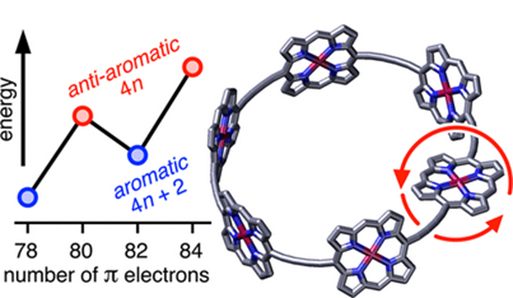
A ring current tells you aromaticity is present. It does not by itself tell you how much stability that aromaticity is worth, which is a harder thing to measure and had only ever been done for rings with 18 pi electrons or fewer. We measured aromatic stabilization energy directly in nanorings with circuits of 76 to 108 pi electrons (Jirásek et al., 2021). The experimental values came out at 1 to 5 kilojoules per mole, and density functional theory calculations, run independently, landed in the same range, 1 to 16 kilojoules per mole. Small numbers on a per-mole basis, but the point was never the size of the energy. It was that the energy is there at all, measurable and consistent with theory, at a scale where most chemists would have expected aromaticity to have faded into an academic technicality.
Where the Size Limit Actually Sits
We pulled this work together, along with related nanoring chemistry from the group, into a review asking the question plainly, does aromaticity have a size limit (Jirásek et al., 2021). The honest answer from our data is that we did not find one. Every ring we built large enough to test still showed a current, still obeyed Hückel’s rule, and still carried a measurable stabilization energy. What changes with size is not whether the physics holds, but how hard it becomes to build a molecule precise enough to test it, and how hard it becomes to detect an effect that is real but small. That distinction, between a rule failing and a rule becoming difficult to observe, shaped how I think about making claims from spectroscopic data in general, and it carried directly into the complexity measurements I work on now.
References
2021
-
 Experimental and Theoretical Evidence for Aromatic Stabilization Energy in Large MacrocyclesJournal of the American Chemical Society, Jan 2021Publisher: American Chemical Society (ACS)
 - From Macrocycles to Quantum Rings: Does Aromaticity Have a Size Limit?Accounts of Chemical Research, Aug 2021Publisher: American Chemical Society (ACS)
2020
-
 Global aromaticity at the nanoscaleNature Chemistry, Jan 2020Publisher: Springer Science and Business Media LLC