Chiral Molecular Materials
Helquats and related chiral chromophores with switchable optical properties.
A helquat is a helicene fused with a cationic dye, a twisted, positively charged polyaromatic strip that cannot lie flat. That twist makes it chiral by construction, and it puts a chromophore, a light-absorbing part of the molecule, inside a helical, electron-poor framework. During my MSc and early doctoral years, working with Filip Teply’s group in Prague, this class of molecules became a way to ask how far molecular shape alone can control measurable optical and electronic behavior. It turned out to control quite a lot, and in one case, something none of us set out to find.
Chirality You Can Switch
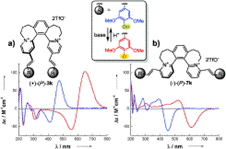
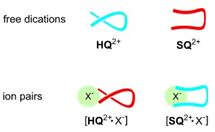
The first helquats resolved into separate enantiomers behaved as helicene-like cationic styryl dyes, and their circular dichroism signal, the measurable difference in how a chiral molecule absorbs left- and right-circularly polarized light, sat in the visible region and could be switched with pH (Reyes-Gutiérrez et al., 2015). That combination, a strong, visible, switchable chiroptical response, had not been seen in helicenoid chemistry before. A separate line of work showed the same molecular class could have its conformational stability flipped by changing the counterion alone, inverting which helical form was preferred without touching the covalent structure at all (Severa et al., 2012). Between the two results, shape and charge environment turned out to be enough to control which enantiomer was favored and how strongly it signaled its own handedness.
Turning Shape Into an Optical Device
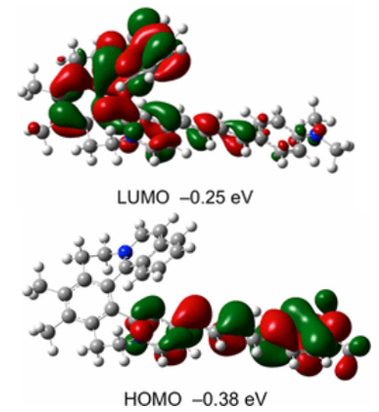
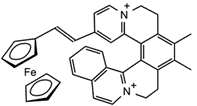
Helical, charge-separated molecules are also good candidates for nonlinear optics, where a material’s response to light depends on the light’s intensity rather than scaling with it linearly. Working with Ben Coe’s group, we attached methoxy and amino donor groups to the helquat acceptor across a series of fourteen new dications and measured how the resulting push-pull structure tuned the second-order nonlinear response (Buckley et al., 2017). A related series built the donor directly from a ferrocenyl group, pairing an organometallic electron source with the same chiral acceptor scaffold (Buckley et al., 2017). Across both series, the same lesson held. The helical geometry was not incidental to the optical properties. It was the reason the charge separation worked the way it did.
An Unplanned Result
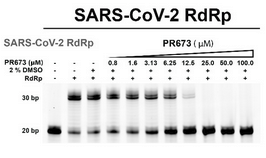
None of this program set out to make an antiviral compound. But a helquat-like molecule from the same synthetic family, PR673, turned out to inhibit the RNA-dependent RNA polymerases of SARS-CoV-2 and tick-borne encephalitis virus, blocking viral RNA synthesis in cell culture (Konkolova et al., 2022). The connection is not obvious until you notice what the molecule actually is, a rigid, charged, helical structure well suited to wedging into a nucleic-acid-binding pocket. It is a reminder that a chemistry program built around one property, optical switching, can hand you a completely different one, antiviral activity, once the right target happens to have a pocket the same shape as your molecule.
The Common Thread
Every result in this group of projects comes back to the same idea, that a molecule’s three-dimensional shape is not a side detail of its function but the mechanism itself, whether the output being measured is a chiroptical signal, a nonlinear optical response, or the binding of a viral enzyme. That is also the assumption underneath the molecular complexity and assembly work I do now, where structure and history are treated as measurable, not just descriptive.
References
2022
-
 A helquat-like compound as a potent inhibitor of flaviviral and coronaviral polymerasesMolecules, Apr 2022
2017
- Tunable Chiral Second-Order Nonlinear Optical Chromophores Based on Helquat DicationsThe Journal of Physical Chemistry A, Apr 2017
-
 Ferrocenyl helquats: unusual chiral organometallic nonlinear optical chromophoresDalton Transactions, Apr 2017
2015
-
 Functional helquats: Helical cationic dyes with marked, switchable chiroptical properties in the visible regionChemical Communications, Apr 2015
2012
-
 Counterion–induced inversion of conformer stability of a [5]helquat dicationChemPlusChem, Apr 2012